Mapping It Out: Place, Space & Time in Susan Lerner's Collage
Susan Lerner is an artist whose work should really be seen in person.
"The integration of imagery can be flawless on the computer, but that’s not what I’m going for,” she explains.
However, when seen on a screen, “flawless” is exactly what her art seems to be. A technically proficient collage artist, Lerner leaves no wrinkles or smears to interrupt the bright colors and smooth forms of her pieces. Photographed and displayed on a computer or phone, her collages become one-dimensional beauties.
Header image: I Never Promised You a Rose Garden by Susan Lerner. 18” x 24” hand-cut collage using vintage imagery and maps on wood panel. Image from the artist's website.
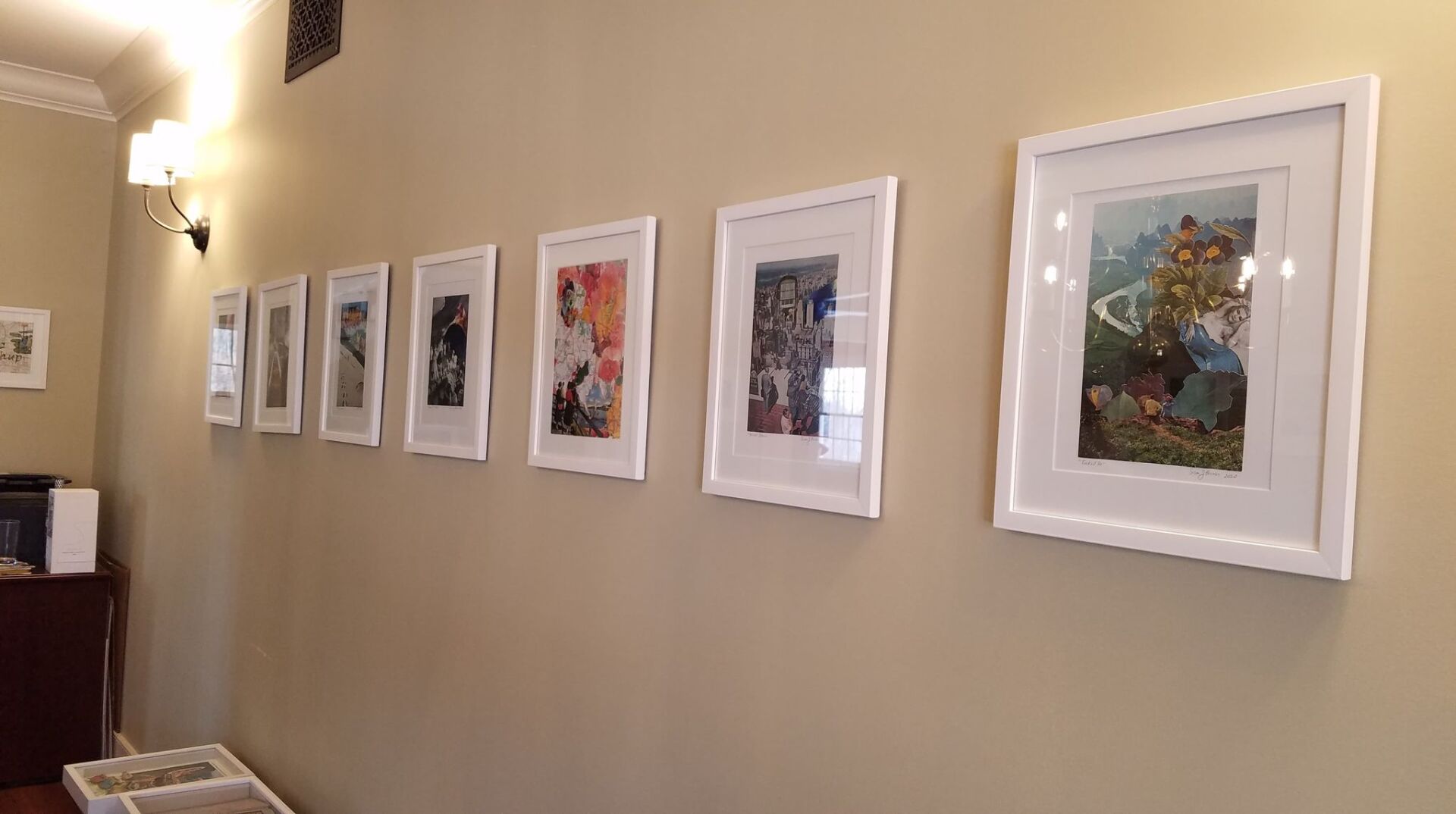
Framed collages hanging in Lerner's Connecticut studio. Photo by Ella Frauenhofer.
Lerner’s reason for preferring the analog over the digital becomes clear when her work is viewed face-to-face. The artist’s concern for a balance of colors and shapes is visible in any format, but seen up close, the care she gives to the interplay of textures in her collages becomes equally evident. Snippets of glossy magazines lay flat with matte segments of old atlases; thick and rigid postcards are visible through fragile fragments of antique books. Lerner never uses photocopies in her work, but instead relies on delicate vintage images wherever she can.
Inspired by the surreal polaroid collages of David Hockney, Lerner first became involved with collage through a class at the 92nd Street Y in New York City, where she is based as an artist (although she also has a home and studio in Connecticut, where she has been spending more time due to the COVID-19 pandemic). “I was on the waitlist for two years,” she recalls. Once she finally made it into the class, it was a meditative outlet from the stresses of daily life including caring for her mother, who was suffering from dementia.
“I liked the tactile feel of the paper,” she says. “Everything was so physical.”
“For me,” she continues, “the process is almost more interesting than the finished artwork - hunting for the images and putting them together.”
Before coming to collage art as her second career, Lerner was a flavor chemist. “A flavor chemist takes individual chemicals and puts them together to create a certain taste,” she explains. Now, she takes individual images and puts them together to create a certain imaginative mood.
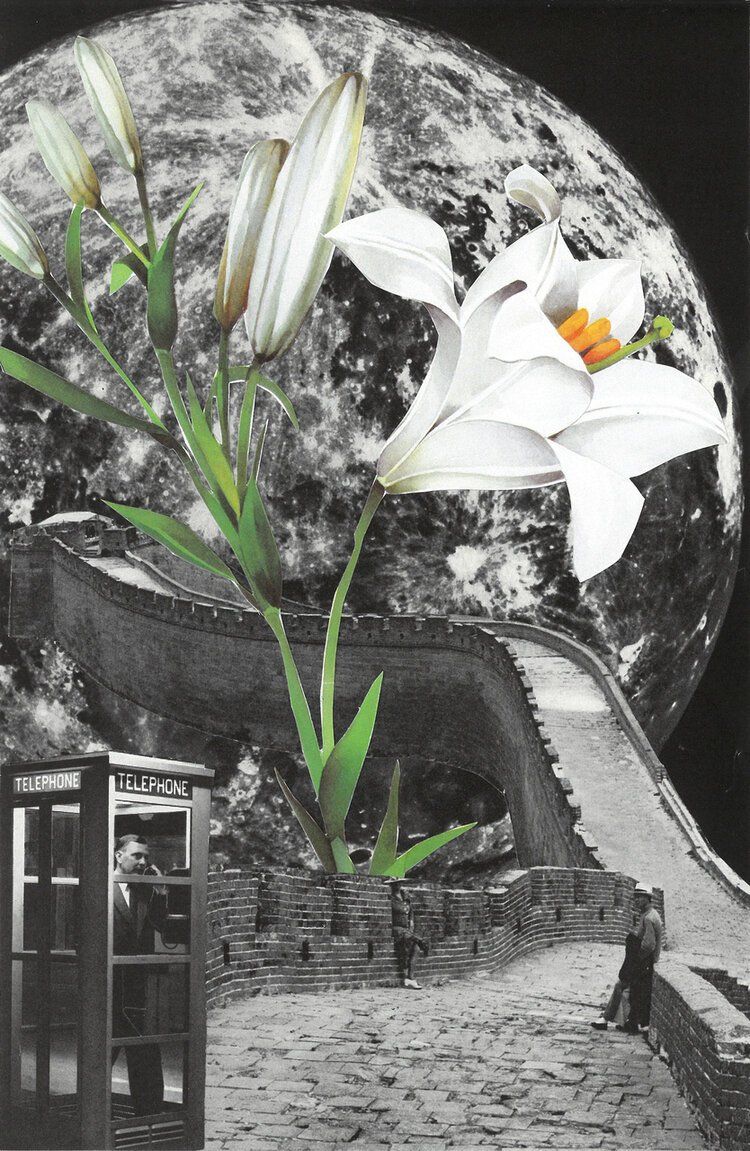
Lost in Space by Susan Lerner. From "Modern Nostalgia." 16” x 13” framed, hand-cut collage using vintage imagery and illustration on bristol board. Image from the artist's website.
Lerner’s first series, “Modern Nostalgia,” is playful and puzzling. This series delights in the power of the out-of-place to baffle a viewer’s sense of perspective: tourists point serenely at surreal landscapes while a man in a business suit makes an important call, unconcerned with the strange goings-on just outside his phone booth.
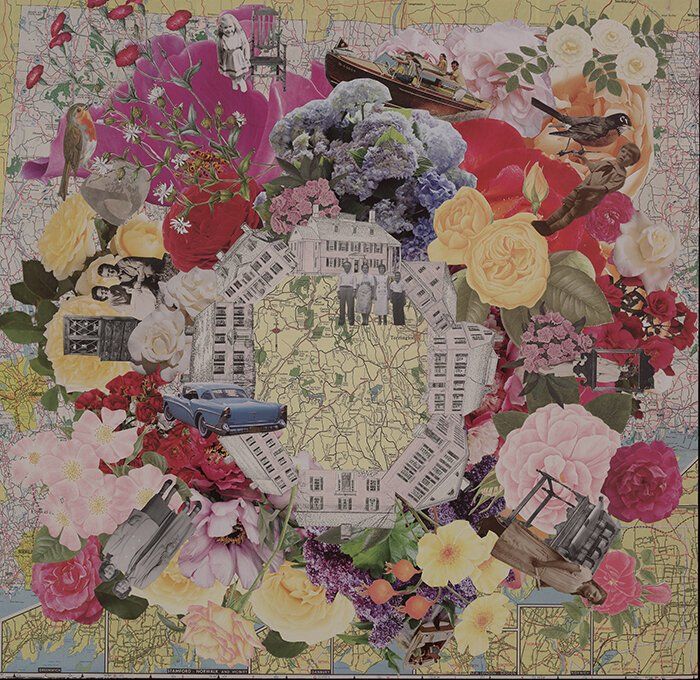
Around Town by Susan Lerner. From "Connect-to-Cut." 24” x 24” hand-cut collage using vintage imagery, maps, illustrations, found photos and colored pencil on wood panel. Image from the artist's website.
In her more recent series, “All Over the Map” and “Connect-to-Cut,” a distinct and individual style emerges. While some collage art embraces the power of rough tears and odd angles, Lerner’s approach is characterized by neatness and meticulousness. Many pieces in these two series employ some degree of symmetry, and the cutting and pasting of different elements is so cleanly done as to be nearly undetectable in many places.
At first glance, the neatness of Lerner’s pieces makes the glossy, smiling images from vintage magazines seem right at home: well-ordered, unchallenging images in a well-ordered, unchallenging world. Only upon a second look does the strange melancholy behind the smiling faces become evident, especially in one of the most visible motifs throughout her work: maps.
Maps figure prominently in many pieces in “All Over the Map” and “Connect-to-Cut,” both as backgrounds and as pieces in the foreground.
“I use maps to take us back to place - to connect us back to space and time,” she explains.
Maps in the foreground are usually cut down to just major roadways which twist over and around other figures in the collage. Still recognizable, most of the context that makes them usable has been removed, leaving only impressions behind. Especially in Lerner’s excavated atlases, where parts of each page have been cut away to reveal the pages below, highways and backroads take on a strangely organic and vascular quality.
Maps in the background, by contrast, are usually complete enough to identify: northwest Connecticut residents especially will recognize their own towns in “Connect-to-Cut,” which incorporates a variety of elements from the area: local architecture, found photos, and especially maps. The vintage maps, however, reference borders and boundaries that have moved, and roads and landmarks that are no more.
“I want to pay homage to the area I’ve been living in for twenty years,” she says. This she does, but her use of vintage imagery also calls to mind the growth, decay, and change that the region has been through. Nothing, the collages seem to say, is permanent: not images, not people, and not the physical world we inhabit.
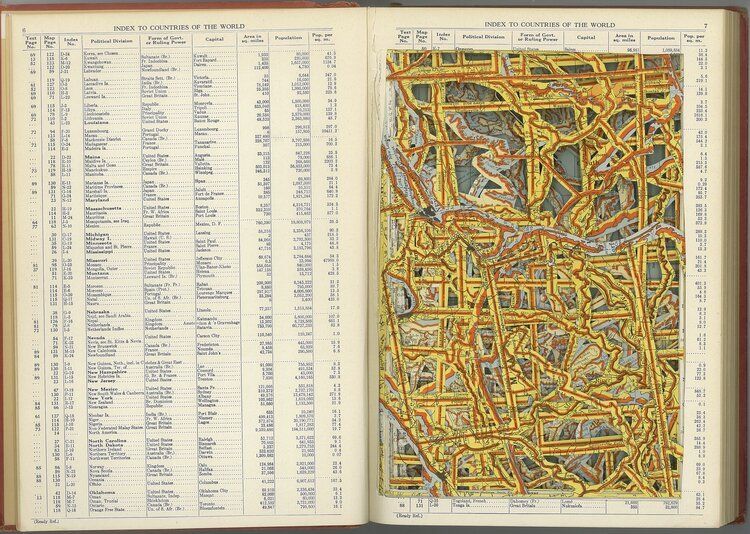
Rand McNally Atlas of the World (1942) by Susan Lerner. From "Connect-to-Cut." 12” x 15” framed shadowbox, excavated atlas. Image from the artist's website.
Although most of Lerner’s work is not sculptural, her excavated atlases again give special insight into why her collages, while still beautiful in photograph, are so much more compelling in person. Seeing her atlases, the viewer is immediately aware that this is a book; specifically, it is a book that has been transformed by the process of making art.
Lerner points out that many of the maps that she uses are artifacts of a particular moment in time, referencing street names and buildings that no longer exist. Viewed one way, Lerner’s collage-making is an act of preservation, enshrining and elevating fragments of ephemera that could easily be moldering away in a basement or a landfill. Like a relic of a medieval saint, however, the process of enshrining these fragments of the past also decontextualizes and destroys them.
Lerner’s vintage image collage implies both a profound interest in these images of the past, as well as a certain irreverence towards them.
Lerner’s work is best seen face-to-face. Symmetry, symbol, and motif survive the digitization of her work, but the sense of the history of the objects and the understanding that Lerner’s process is as much one of destruction as of creation must be experienced up close and in person.
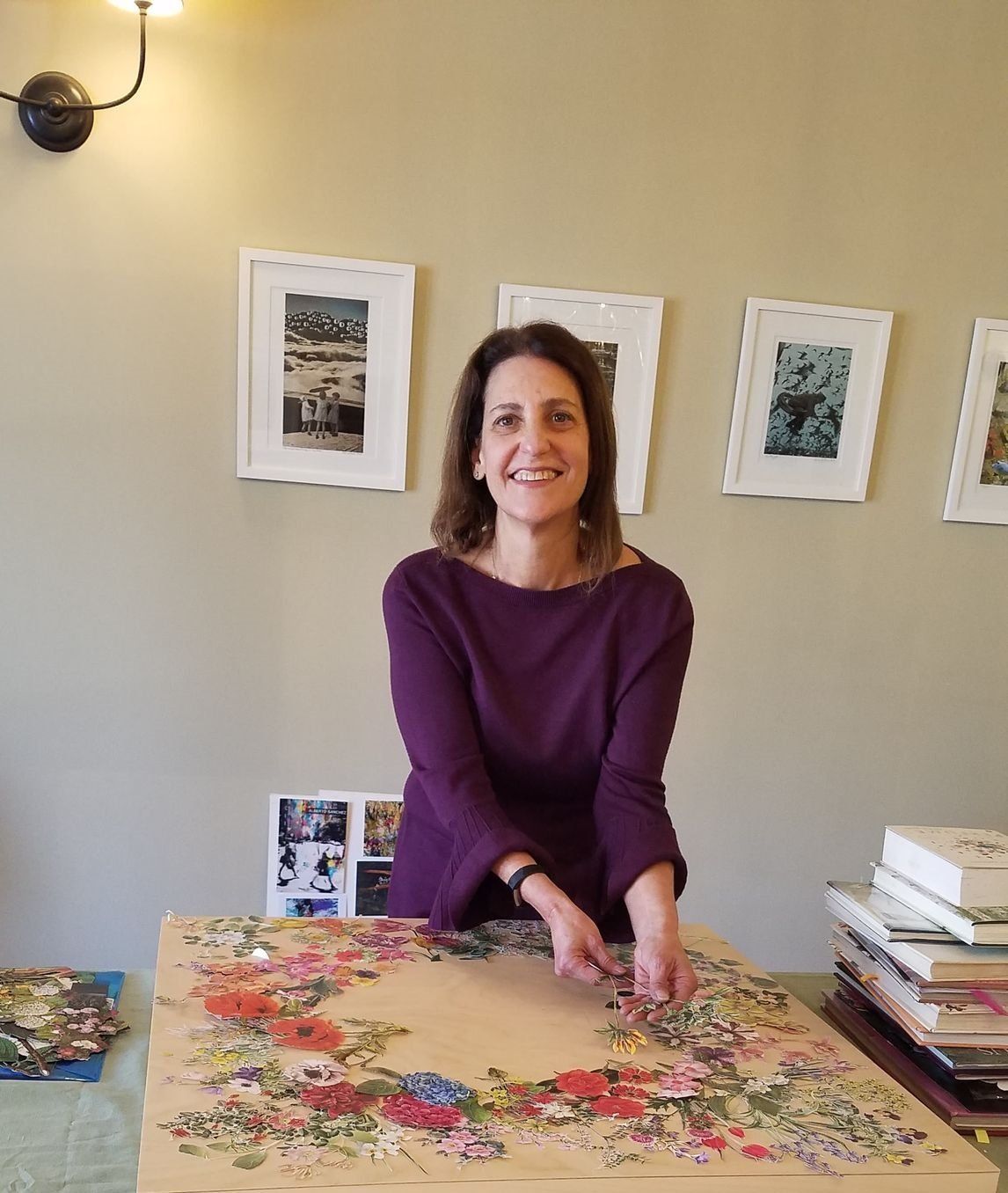
Susan Lerner working in her Connecticut studio. Photo by Ella Frauenhofer.
Currently, Lerner is working on a series on the senses which is still in its early stages. “I’m playing with imagery,” she explains. “Nothing is set in stone - it may look very, very different when I’m done.” The series will be part of a solo exhibition in 2023.
Lerner is also starting to incorporate mixed media and hand-coloring into her work. “I try to always challenge myself. I’m seeing where I can go, where I can learn new techniques. My art is ever changing, which is part of the fun of it.”
-
Susan Lerner is one of the founding members of @NYCollageEnsemble, a group whose work has been shown internationally. Her own collage has been featured in Litchfield Magazine, on LinkNYC kiosks throughout the five boroughs, and group shows throughout the United States and in Germany, Russia, Scotland, and Norway. Several of her pieces are held by the Kanyer Art Collection, an international collection of work by collage artists from 1980 to the present.
Susan Lerner’s work will be featured in a group show at Studio Hill Gallery, opening on March 16, 2022 and closing on April 16, 2022. The reception is March 20, 2022 from 3 PM to 5 PM. To learn more about Susan’s art, visit https://www.mixdmediamashup.com/. To learn more about the show, visit https://www.studiohillct.com/.